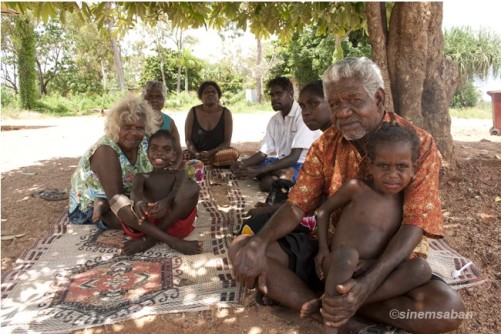
The Yolngu people are located in the Northeast of the Arnhem Land in the Northern Territories of Australia. According to FilmAustraliaCeremony.com.au, their region covers more than 40,000 square kilometers of the Arnhem Land and there are more than 50 Yolngu clans located in the area. EALTA.org states that the Yolngu have occupied their lands for at least 50,000 years, which was recorded through their paintings, dances and songs. This land is aboriginal land and visitors need a permit to travel there.
The Gove Peninsula has two main settlements--Yirrkala and Nhulunbuy. Yirrkala is a small indigenous town with a population of 800. On the other hand, Nhulunbuy is a mining town constructed in the 1970's to help develop an open-cut bauxite mine. The town is now the fourth largest town in the Northern Territory.
Image from http://www.filmaustraliaceremony.com.au/s1_2.htm
Image from http://www.dxing.info/dxpeditions/nhulunbuy_2005_12.dx
Our Generation is a film documentary that takes a deeper look into the lives of indigenous Australians whom are threatened by the governments power. We have seen this similar political issues between native peoples. In this case, the government does not acknowledge the rights of these indigenous people and have even taken away their land. As a group of people who survive mostly off of the natural resources around them, taking away their land puts their existence at risk.
Our Generation
Reference:
YouTube
Saban, Sinem and Damien Curtis. Our Generation documentary. http://www.youtube.com/watch?v=ElW6M0hU7jo. 2010.
The Yolngu people do not have many issues concerning gender
differences. Women and men share some of the same roles and social status.
However there are some minor differences. In a family, usually, the oldest son
or male will have the superior authority and leadership role but since there is
not a strict separation between the two sexes, birth order is also taken into
account and power can be shown in the oldest daughter.
The is a custom
practiced by the Yolngu people called mirrirri which is a type of avoidance
behavior between certain relationships for example a wife has to avoid her
brother. Any sexuality references made
toward or around the brother about his sister or sisters is prohibited. These
are also a part of the Ngarra law which again, comes with its harsh punishments
if broken.
In public, men are
more likely to show authority but that does not mean women are excluded from
power, influence, and leadership positions. The only time when these positions
are not available to women are during certain ceremonies that men are
responsible for and hold all the power for. During public meetings, although
women have to sit on the outskirts among the other people at the meeting,
senior women are allowed to interject and comment if needed. Women show the most
power and authority in education.
Special Occasion - Gender roles switch for "comic relief"
Reference:
Morphy, Frances.
Whose gevernance, for whose good. The Laynhapuy
Homelands Association and the neo-assimilationist turn in Indigenous policy:
The Yolngu ‘World.’ Australian National University. http://epress.anu.edu.au/caepr_series/no_29/mobile_devices/ch05s03.html
Gaymarani, George Pascoe
2011, An
Introduction to the Ngarra law of Arnhem Land. http://www.nswbar.asn.au/circulars/2011/jul/ngarra.pdf
Marriage is a Yolngu’s right according to the sacred law of Ngarra in a complex kinship system called Gurrutu. Breaking the marriage laws of Ngarra is seen as dishonoring and can result in harsh punishment such as being taking a spear through the leg. Girls as young as 13 to 16 are arranged to be married by their parents to a man between 40 to 50 years of age and is most likely a cousin from her father’s side just like men marry a cousin from their mother’s side. Although these marriages are arranged, the girls are not expected to marry until they are sexual mature. The Yolngu people are divided into two moieties, or two groups divided into other sub parts within, the Dhuwa and Yirritja. Marriage usually stays within the same moiety. Polygamy is also permitted and socially acceptable and preferred in the Yolngu culture. These marriages allow for moieties to interlink and create alliances.